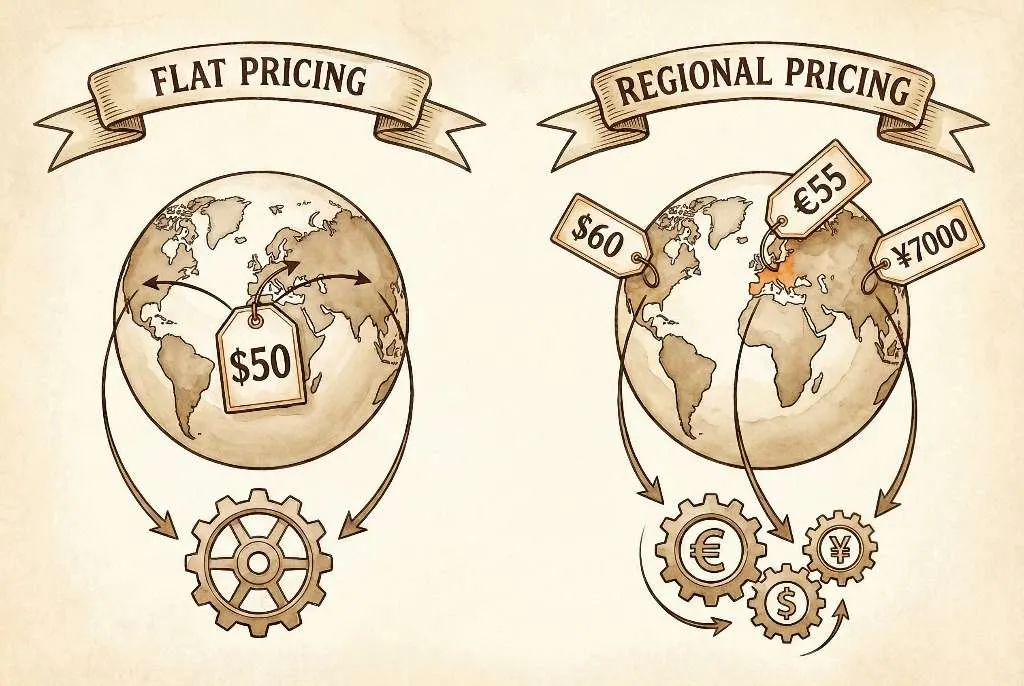
Compare regional pricing with flat global pricing to decide which model fits your product and markets.
Choosing between flat global pricing and regional pricing is one of the most important decisions for global growth. Both approaches can work, but the right choice depends on your market, product, and operational capacity.
If you serve multiple continents or wide income ranges, the tradeoffs become significant. Flat pricing favors simplicity, while regional pricing favors alignment with local affordability and competition.
Pros
Cons
Flat pricing also puts pressure on customer support and retention in markets where pricing is perceived as unfair or disconnected from local income.
Pros
Cons
Regional pricing may also require stronger billing localization and policy clarity to avoid cross-region arbitrage.
Consider these factors before choosing a model:
Also consider operational capacity: tax handling, payment method coverage, and your ability to communicate price changes clearly across regions.
If you need a structured approach, see Global Pricing Strategies.
If your product has heavy support or compliance costs in certain regions, you may choose flat pricing or a limited tier model to avoid margin erosion.
Some teams use a hybrid model:
Hybrids often work well when you have a large self-serve user base but still want enterprise pricing flexibility.
If you want to model country-based prices, try the regional pricing tool.
When should I keep flat global pricing?
Flat pricing works best when most of your demand is in a narrow set of similar markets or when operational simplicity is critical.
Is regional pricing worth the extra complexity?
It often is for products with global reach and diverse income levels, especially for digital goods and subscriptions.
How do I communicate regional pricing differences?
Be clear about local pricing and currency. Avoid comparing prices across markets in marketing copy.
Can I start flat and switch to regional pricing later?
Yes. Many teams start flat, then introduce tiers once they see demand outside their home market.
Does regional pricing cause customer complaints?
It can if communication is unclear. Clear local pricing and consistent policies reduce confusion.
Flat pricing is simple but can be limiting. Regional pricing is more complex but often leads to stronger long-term growth. The right choice depends on your product, market, and operational readiness.
For a simple primer, start with What is Regional Pricing.
Written on: Jan 19, 2026